


Pay transparency law in Romania: Where it stands
Status 21 November 2026. We update this page when something changes. This is general information, not legal advice.
The current status
EU directive in force
Directive (EU) 2023/970 had to be transposed by 7 June 2026. The European Commission confirmed there will be no delay.
Romanian law still in parliament
Draft law L445/2026 reached the Senate in June 2026. The Senate rejected it on 14 October 2026 and sent it to the Chamber of Deputies, which has the final vote. When it will vote is open.
No inspections yet
The new reporting and information duties can only be enforced once the law is published in the Monitorul Oficial. Equal pay for equal work is already required today, and employees can already go to court.
What applies to your company
Some obligations apply to every employer, the report depends on size. Headcount is counted per company in Romania.
Every employer
A pay range before the interview, no question about previous pay, information for employees on request and objective criteria for pay.
100 to 149 employees
Plus a pay gap report every three years, first in June 2031.
150 to 249 employees
Plus a report every three years, first on 7 June 2027 with data from 2026.
250 employees or more
Plus a report every year, first on 7 June 2027 with data from 2026.
Deadlines under the directive and the Romanian draft
01
From transposition
Pay ranges before the interview, no questions about previous salary, information rights for employees (30 working days in the Romanian draft), objective pay criteria.
02
7 June 2027
First pay gap report, based on 2026 data, for employers with 250 or more employees (then yearly) and 150 to 249 employees (then every three years).
03
7 June 2031
First report for employers with 100 to 149 employees.
Four terms, briefly explained
Pay gap
The difference in average pay between women and men, in percent. The report shows it for the whole company and per group.
Work of equal value
Different jobs that are worth the same in terms of skills, effort, responsibility and working conditions. Which ones they are is decided by management.
Right to information
Employees can ask for their pay and the average pay of women and men in their group. The Romanian draft provides 30 working days for the answer.
Joint pay assessment
If the report shows a difference of 5% or more in a group that is neither justified nor closed within six months, the employer examines the causes with the employee representatives.
What you can do now
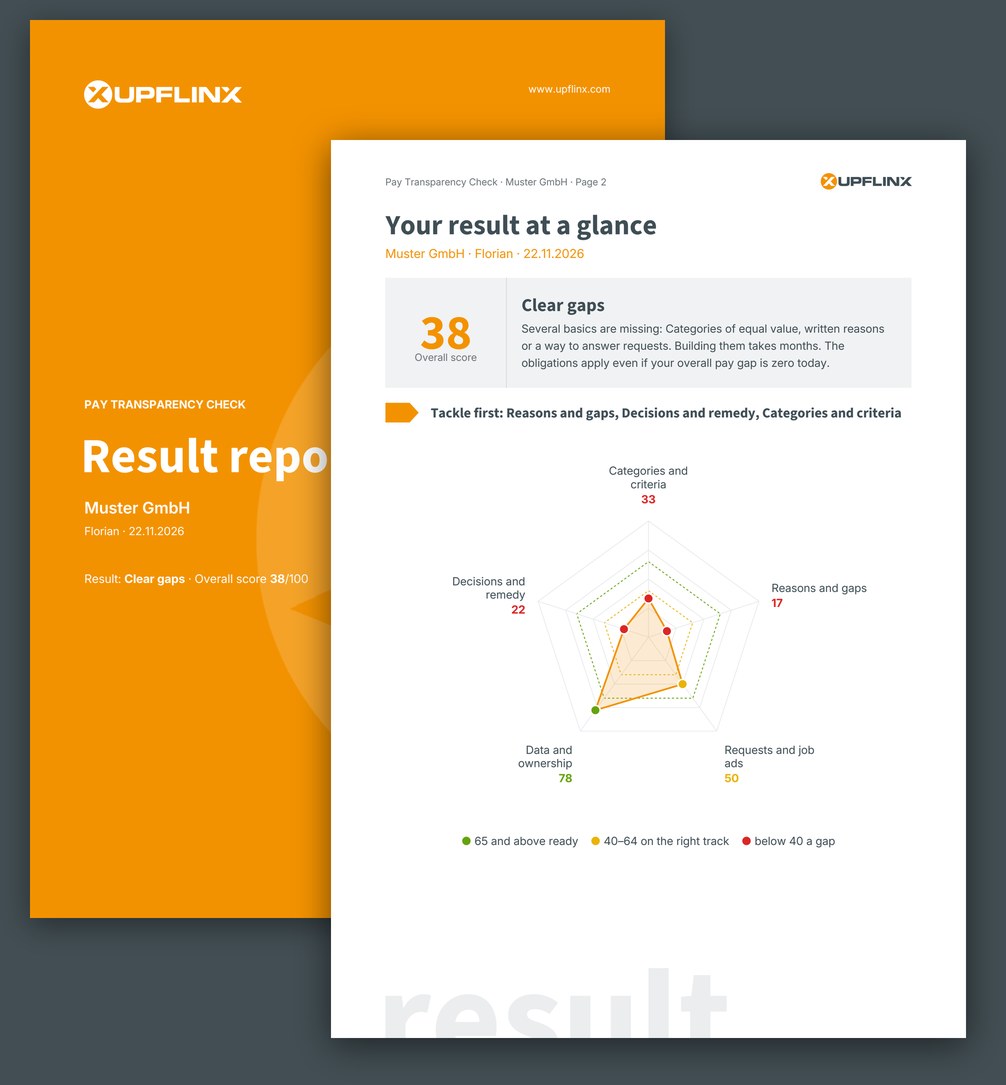
Take the self-test
About ten minutes, free of charge. It shows where your company stands on the main duties of the directive.
Secure clean 2026 payroll data
The first reports use pay data from 2026. Keep job, salary and allowances complete and consistent for every employee, as you report them to REGES-Online.
Start with a first check
Which jobs are of equal value, also across departments, pay compared within these categories, and the questions management must answer. Seven to ten working days.
From €1,500net, depending on company size
Where does your company stand?
The self-test takes about ten minutes. It shows where your company stands on the main duties of the directive. Free of charge.
Questions
The deadline comes from the directive. The Romanian draft takes it over. Whether the final law changes it is open, so plan with June 2027.
The committee reports in the Senate mentioned three to five gross minimum wages, five to ten for repeated breaches. The final law may differ. The larger risk is damages in a lawsuit, which the directive does not cap.
As long as the law is missing, the new obligations are not inspected. But employees can already sue today, and in a dispute the employer has to prove that a difference has nothing to do with gender. Once the law applies, fines are added, and an unjustified gap of 5% or more leads to a joint pay assessment.
Yes. It applies to every employer with staff in Romania, per legal entity.
What does this mean for your company?
Pick a time for 30 minutes by video. Free of charge.