Insights

Answers for management and HR in Romania

Here we answer the questions that managing directors, finance leads and HR teams in Romania ask us most often. Each answer comes first, followed by background, examples and sources. Every article carries a review date and is updated when the law or the practice changes.

All articles

What is work of equal value, and who decides which jobs are comparable?

The four criteria of the EU Pay Transparency Directive, how to group different jobs step by step, and who has a say: management, HR, employee representatives and, in a dispute, the court.

Read More

What is an AI agent, and how does it work? The basics for HR and management

How an AI agent differs from a chatbot, what it does step by step, where it fails, and which guardrails HR and management should set before one gets access to company systems.

Read More

What does a fractional HR director do, and when does it make sense?

What a part-time HR director takes on, how the role differs from an employed HR director, an interim manager, a consultant and outsourced HR administration, and when it fits.

Read More

Your Romanian subsidiary and pay transparency: what headquarters needs to know

Each Romanian company in your group has its own pay transparency duties, whatever the status at home. What group headquarters should ask, decide and request now.

Read More

Pay range before the interview, no question about salary history: how does hiring change under pay transparency?

What candidates must learn about pay before the interview, which question you may no longer ask, how wide a range can be and what to change in job ads, interviews, offers and your ATS. With a checklist.

Read More

What is a job architecture, and where does a company with 150 to 500 employees start?

Job families, levels, categories and pay ranges in plain words, and the steps a mid-sized company in Romania takes to build its job architecture from the payroll it already has.

Read More

How do you read a pay gap figure without misjudging it?

Overall or per category, mean or median, and when the 5 % threshold matters. A worked example with an invented company of 200 people and a checklist for management.

Read More

How do AI chatbots work, and what does that mean for HR?

What a chatbot really does when it answers, why it can be confidently wrong, and which HR tasks it handles well today and which it should not touch.

Read More

Which court rulings explain pay transparency, and what do they mean for employers in Romania?

Seven rulings from the EU Court of Justice, the German Federal Labour Court and the Romanian equality body, each explained in three questions, and what follows for your company.

Read More

An employee asks what colleagues earn: how do you answer a pay information request?

Who may ask, what the directive requires you to disclose, which deadline applies and how to answer in writing without revealing anyone's salary. With a step-by-step procedure and a checklist.

Read More

What belongs in an AI policy for employees, and how do you make it stick?

The ten building blocks of an AI policy for employees, with example wording, and how to introduce it so that people actually follow it. With a checklist.

Read More

Topics

Pay transparency

What the EU directive and the Romanian draft require, by when, and for whom.

To the topic

Pay and job structures

Categories of equal value, pay ranges and objective criteria, built so that every pay decision can be explained.

To the topic

HR organisation

Fractional HR, subsidiaries of international groups and HR processes that run without a full-time director.

To the topic

AI in HR

Using AI in HR work with clear rules: what helps, what to avoid, and what the AI Act requires.

To the topic

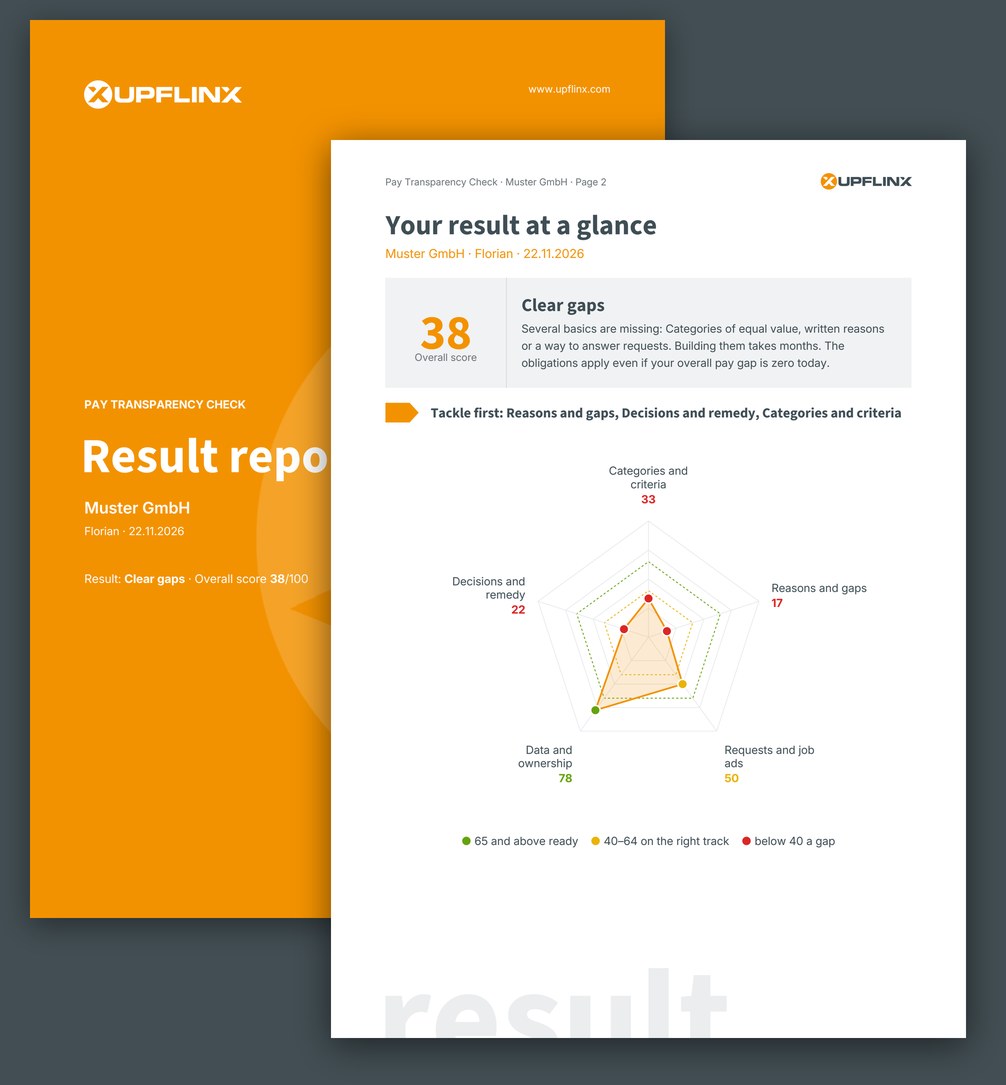
Where does your company stand?

The self-test takes about ten minutes. It shows where your company stands on the main duties of the directive. Free of charge.
Start the self-test
Sample result report of the UPFLINX pay transparency self-test